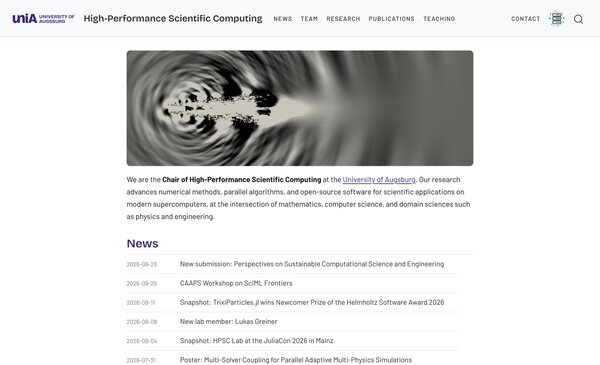
The High-Performance Scientific Computing Lab has a new website: everything from the old one has come along, now with a clearer structure and a few things that were missing before.
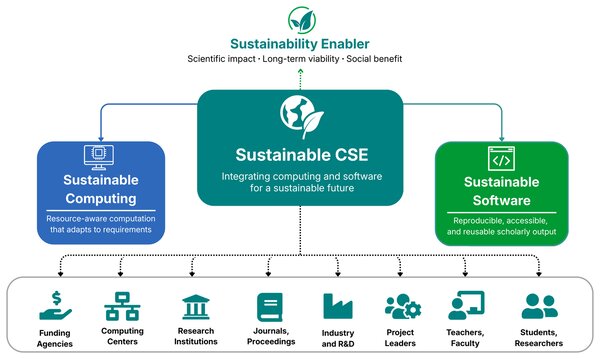
Together with more than 40 colleagues from across the computational science and engineering community, we have submitted our paper “Perspectives on Sustainable Computational Science and Engineering”.
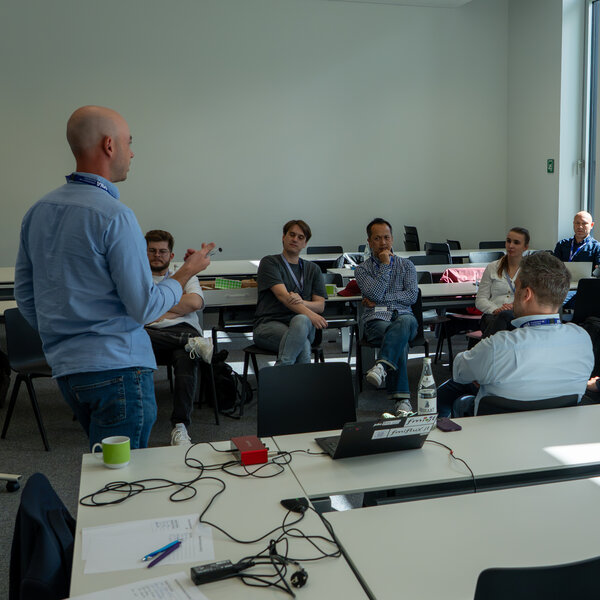
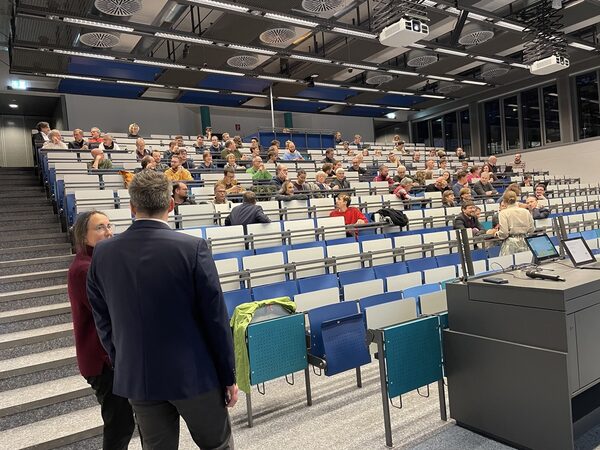
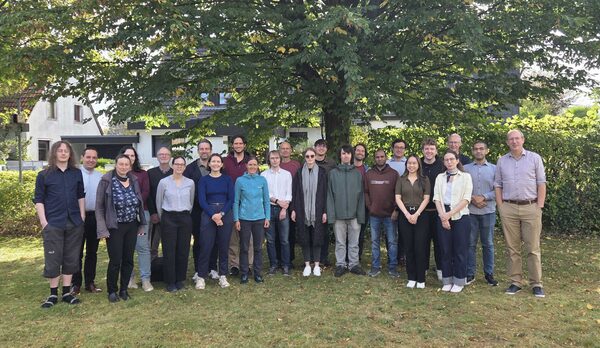
On 22nd and 23rd September 2026, we hosted the CAAPS workshop “SciML Frontiers: Progress, Evolution, and Future Directions” at the University of Augsburg.
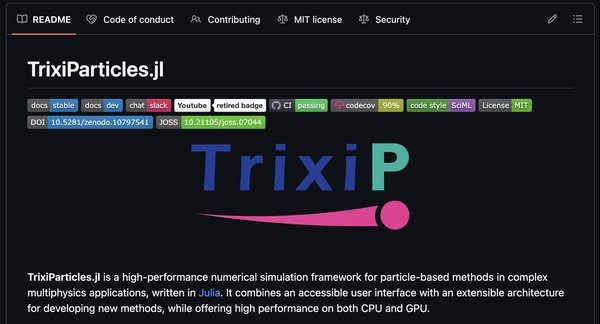
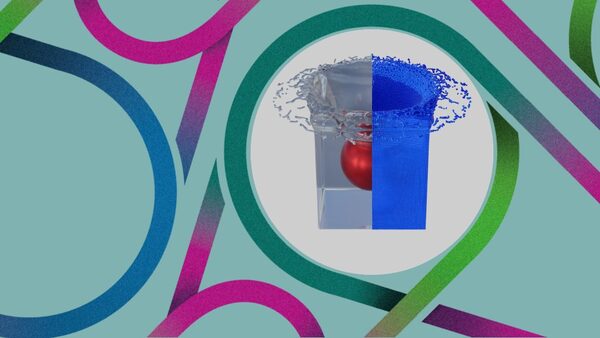
Our particle-based multiphysics simulation framework TrixiParticles.jl wins the Newcomer Prize of the Helmholtz Software Award 2026.
Lukas Greiner has joined the High-Performance Scientific Computing Lab on 1st September 2026 as a PhD student.
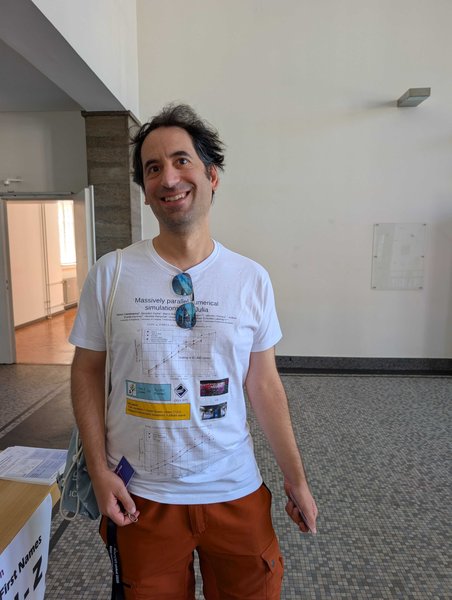
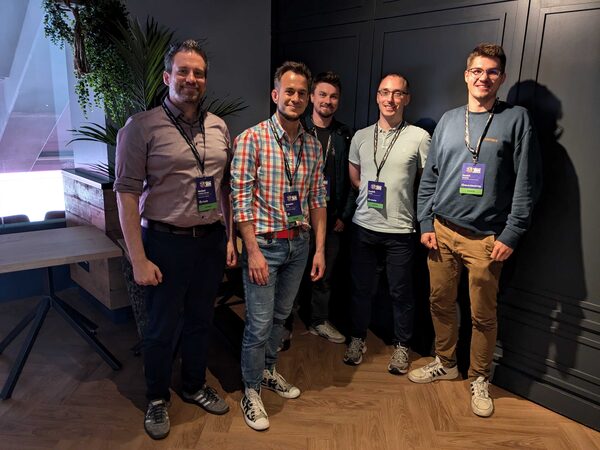
Our group members Vivienne Ehlert and Simon Candelaresi participated in this year’s JuliaCon in Mainz where they presented their work and connected with other participants.
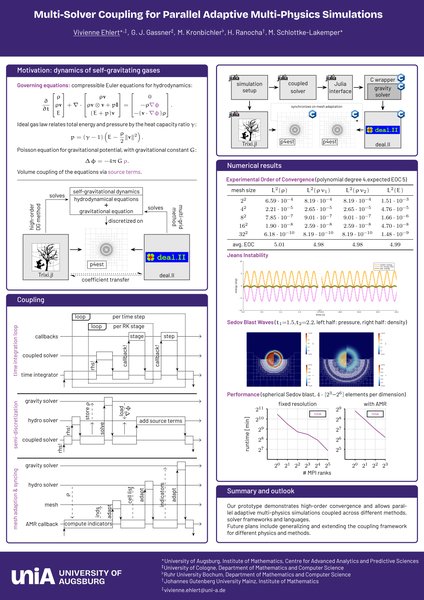
During the Foundations of Computational Mathematics conference in Vienna, Vivienne presented a poster titled “Multi-Solver Coupling for Parallel Adaptive Multi-Physics Simulations”.
Simon gave a talk at the ASTRONUM 2026 on the latest developments on adaptive multiphysics coupling.
On 20th July 2026, Michael gave a talk titled “High-Performance Multiphysics Simulations with Heterogeneous Models and Computing Architectures” at the WCCM-ECCOMAS 2026 conference in Munich.
Our lab member Valentin Churavy is joining Saarland University to build up a new interdisciplinary research group at the intersection of the Center for Scientific and High-Performance Computing and the…
The paper is the result of a collaboration between Daniel Doehring, Jesse Chan, Hendrik Ranocha, Michael Schlottke-Lakemper, Manuel Torrilhon and Gregor Gassner.
The paper is the result of a collaboration between Arpit Babbar, Valentin Churavy, Michael Schlottke-Lakemper and Hendrik Ranocha.
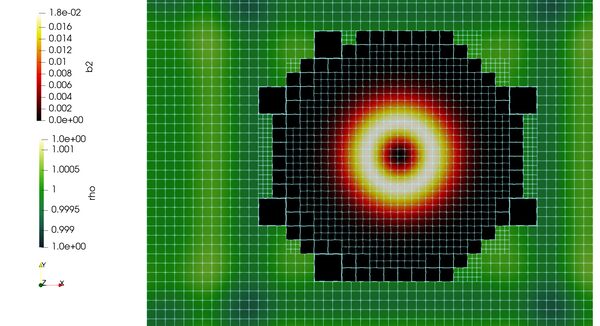
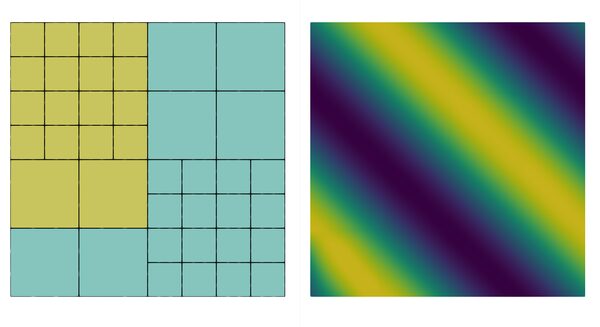
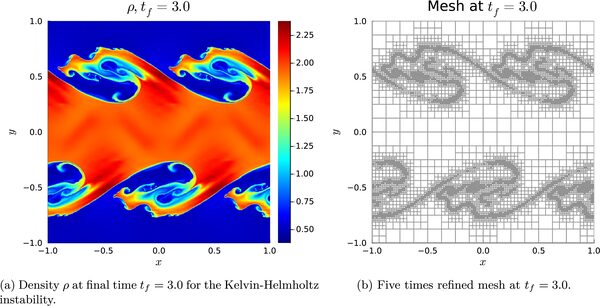
Using Trixi.jl we implement combined adaptive model selection (AMS) and adaptive mesh refinement (AMR) for coupled multiphysics simulations.
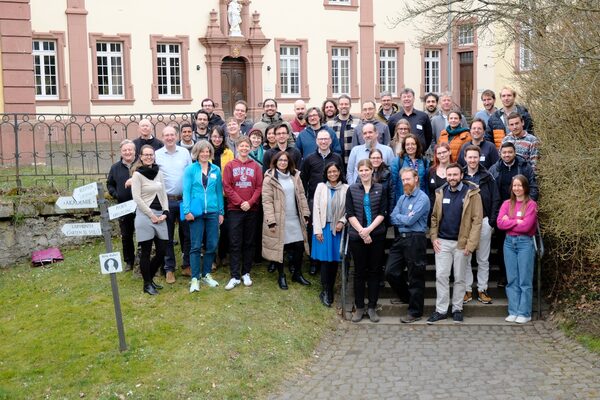
The first TRUDI (Trixi User and Developer Interaction) workshop was organized by the University of Cologne during the 16th - 20th of March 2026.
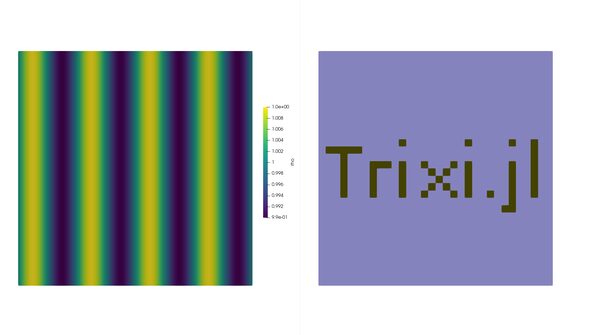
Using the numerical code Trixi.jl
On November 24, 2025, the HPSC Lab organized a public lecture entitled “AI and Climate: Does this work?” as part of the University of Augsburg’s participation in the Public Climate School.
During the 2nd and 3rd December we hosted the CAAPS workshop Demystifying Numerical Dissipation in Simulation Codes.
On the 2nd and 3rd of December, we will be hosting the CAAPS workshop Demystifying Numerical Dissipation in Simulation Codes at the University of Augsburg (building I2, room 1309).
On 27th October 2025, Elisabeth Gaar, professor of optimization, and HPSC Lab’s Michael Schlottke-Lakemper gave their inaugural lectures at the University of Augsburg.
The paper is the result of a collaboration between Niklas Neher, Erik Faulhaber, Sven Berger, Christian Weißenfels, Gregor Gassner, and Michael Schlottke-Lakemper.
Our new paper “Fourth-order paired-explicit Runge-Kutta methods” has been published in the journal Computational Science and Engineering.
This year’s biennial KLAIM focused on coupled problems.
Our HPSC Lab members Michael Schlottke-Lakemper, Simon Candelaresiand Vivienne Ehlert attended the annual SNuBIC retreat during 22nd to 24th of September this year.
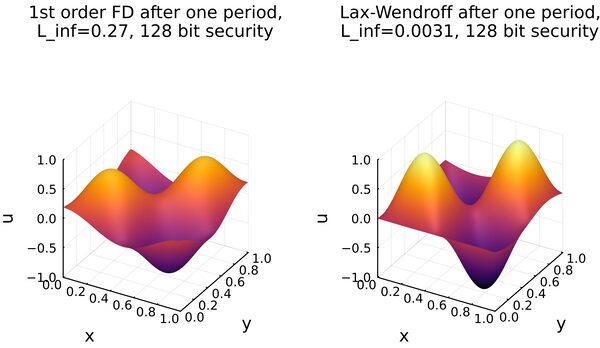
This week, our team published the paper “Secure numerical simulations using fully homomorphic encryption” in Computer Physics Communications.
On September 16th and 17th, the HPSC Lab gave a hands-on workshop on reproducible scientific computing and HPC using the Julia programming language.
Using p4est meshes for our simulations we implemented flexible multiphysics coupling across interface boundaries in Trixi.jl.
Together with Erik Faulhaber, Sven Berger, Christian Weißenfels und Gregor Gassner, we have submitted our paper “Robust and efficient pre-processing techniques for particle-based methods including…
Together with Arpit Babbar and Hendrik Ranocha, we have submitted our paper “Automatic differentiation for Lax-Wendroff-type discretizations”.
On 27th May 2025, Michael gave a talk titled “Sustainable research software for accessible high-performance computing” during the 39th Workshop on Sustained Simulation Performance (WSSP) at the…
Vivienne Ehlert has joined the High-Performance Scientific Computing Lab on 15th May 2025 as a PhD student.
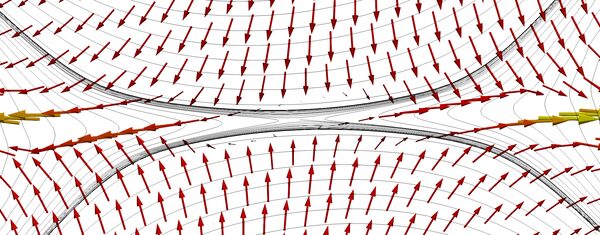
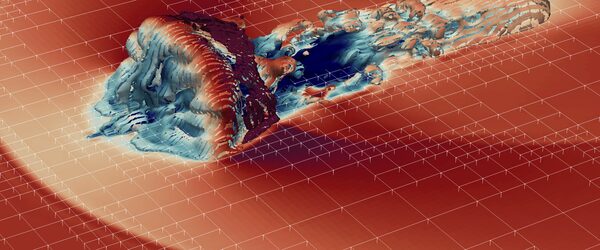
We use Trixi.jl in a 2d simulation of reconnecting magnetic flux tubes.
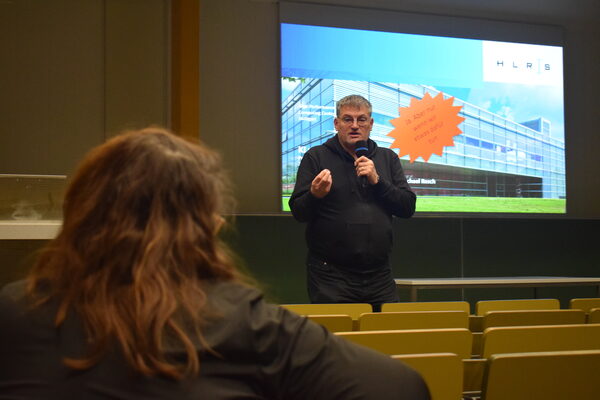
Today on 6th May 2025, Johannes Gebert of the High-Performance Computing Center Stuttgart ( HRLS) visited us at the HPSC Lab at the University of Augsburg.
Between March 16 and 19, 2025, the HPSC Lab participated in the Kármán Conference on Sustainable Computational Science & Engineering 2025
At the CSE25 conference Simon Candelaresi gave a talk on the latest developments on multiphysics coupling in Trixi.jl.
Together with Yanick Kiechle from the Heinrich-Heine Universität Düsseldorf, we organized a minisymposium on numerical methods for coupled multiphysics problems at the CSE25 in Fort Worth, TX.
Our paper “Generalized upwind summation-by-parts operators and their application to nodal discontinuous Galerkin methods” has been published in the Journal of Computational Physics.
On the 30th of January the High-Performance Scientific Computing Lab hosted the SNuBIC Fellow meeting.
TrixiParticles.jl is a Julia-based open-source package for particle-based multiphysics simulations and part of the Trixi Framework.
Valentin Churavy has successfully applied for a travel grant at the Bavaria California Technology Center (BaCaTec, https://bacatec.de).
Our new paper “HOHQMesh: An All Quadrilateral/Hexahedral Unstructured Mesh Generator for High Order Element” has been published in the Journal of Open Source Software.
On Wednesday, 18th December 2024, 4pm, we host the CAAPS Connect event “Julia for Scientific Computing and Data Science” at the University of Augsburg.
At this year’s MHD Days our group member Simon Candelaresi presented his latest work on adaptive model selection in multiphysics coupling using Trixi.jl.
Our new paper “On the robustness of high-order upwind summation-by-parts methods for nonlinear conservation laws” has been published in the Journal of Computational Physics.
HPC numerical codes have been largely developed using Fortran or C due to their speed.
Together with Yuriy Polyakov from Duality Technologies Inc.
{fig-alt=“Workshop on Particle-based simulation methods 5-6 Nov 2024” width=700}
On August 1st, 2024, Valentin Churavy has joined our team in the HPSC Lab as a postdoctoral researcher and research software engineer.
Simple physical systems can be simulated using a single model.
In today’s world, data security and privacy are critical, especially when sensitive information is processed on potentially insecure systems, such as in cloud computing.
From July 9th through 13th, JuliaCon 2024 took place at the PSV soccer stadium in Eindhoven, Netherlands.
Simon Candelaresi has joined our team at the University of Augsburg on July 1st as a postdoctoral researcher.
2D single-phase simulation of the liquefaction of the Julia logo with TrixiParticles.jl.
Our new paper “Multirate Time-Integration based on Dynamic ODE Partitioning through Adaptively Refined Meshes for Compressible Fluid Dynamics” has been published in the Journal of Computational…
Ioana Lupu has joined our group on 1st June 2024 as the new team assistant.
The High-Performance Scientific Computing Lab focuses on the development of high-performance computing software and algorithms for scientific applications at the intersection of mathematics…