Talk: Homomorphic encryption for medical image processing
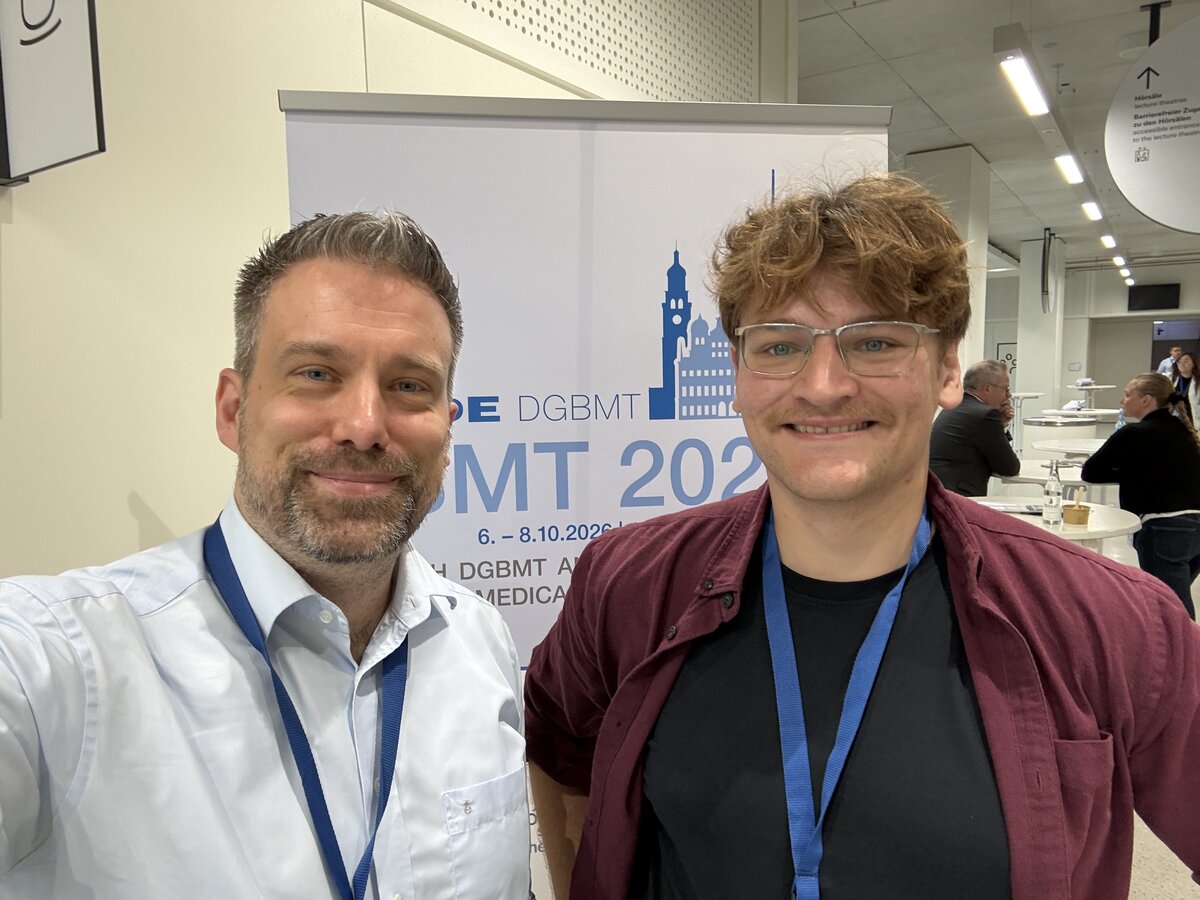
On 8th October 2026, our former student research assistant Max Grübmeyer gave a talk titled “Towards privacy-preserving medical image processing using homomorphic encryption” at BMT 2026, the 60th Annual Conference of the German Society for Biomedical Engineering (DGBMT), which this year was hosted in Augsburg by the university and the university hospital.
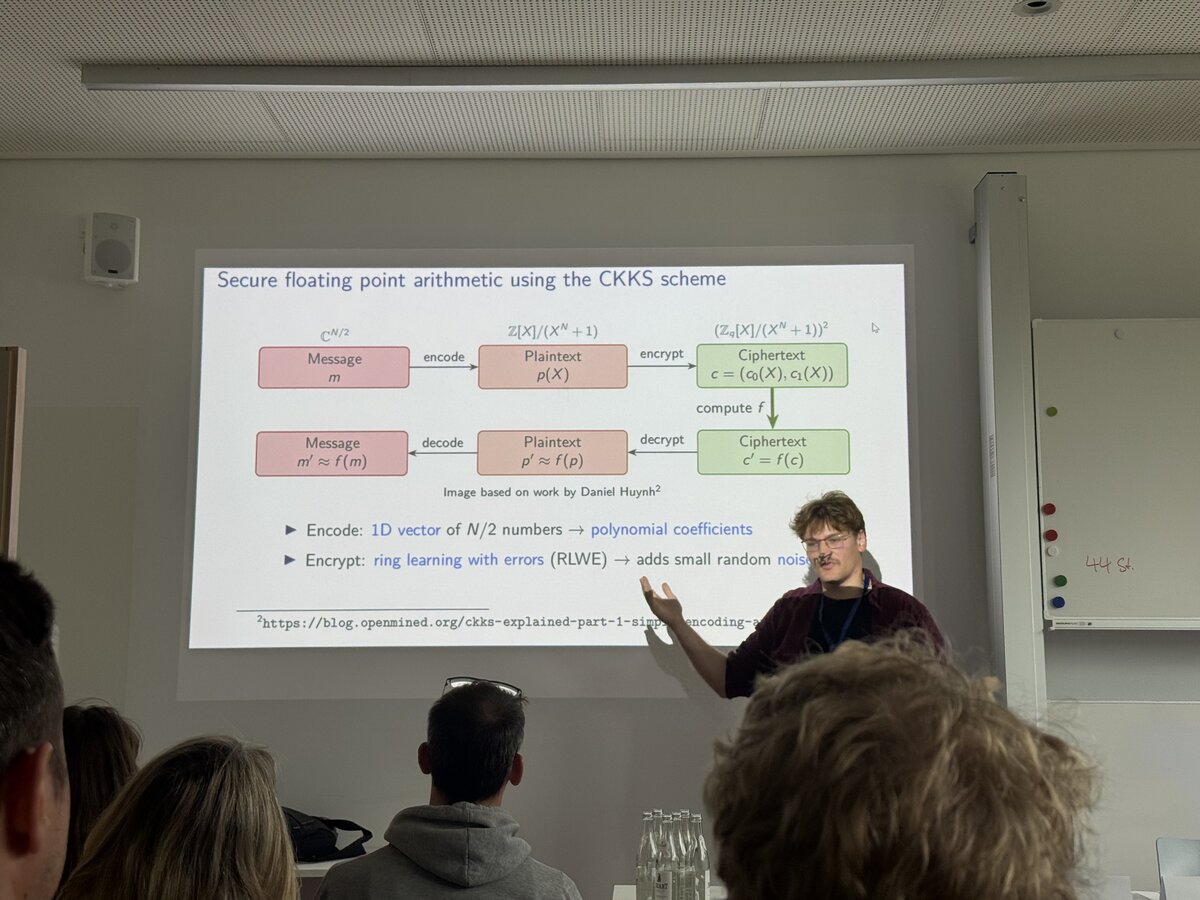
In his work at the HPSC Lab, Max developed an algorithm for applying the Laplacian of Gaussian filter to 3D head CT data. The talk presented collaborative work between our lab and Thomas Wendler (University Hospital Augsburg). Together with further algorithmic developments, these results are to be published as a journal paper that is currently in preparation.
His talk was well received, and we congratulate Max on his first contribution as a young researcher at a scientific conference! Since this summer, Max has been pursuing a Master’s degree in applied mathematics at EPFL in Lausanne, Switzerland, for which we wish him all the best (and hope for an eventual return to Augsburg).
Abstract. Introduction. The use of cloud-based services for medical image processing is limited by strict data protection requirements (e.g., HIPAA, GDPR). This is particularly critical for volumetric data such as 3D head CT scans, where anatomical structures can enable reconstruction of facial geometry and thus potential re-identification, even when metadata are removed. Fully homomorphic encryption (FHE) offers a promising approach by enabling computations directly on encrypted data.
Methods. We present a framework for processing multidimensional medical imaging data using the Cheon–Kim–Kim–Song (CKKS) scheme. A common characteristic of FHE is that it natively supports only one-dimensional vector operations, which complicates the implementation of algorithms for inherently multidimensional data such as 2D/3D CT or multiparametric MRI. To address this, we introduce a simple, high-level multidimensional array abstraction built on top of ciphertext vectors, together with corresponding shift operations, enabling the direct formulation of stencil- and convolution-based algorithms.
Results. As a demonstrator, we implement Laplacian of Gaussian (LoG) filtering for 2D and 3D head CT data using different kernel sizes. The results show that the encrypted computations reproduce the unencrypted “plaintext” results with high numerical accuracy, while remaining straightforward to implement using the proposed abstraction. However, the computational cost remains significant: while plaintext implementations run in seconds, encrypted 3D computations can require more than an hour for large kernels on a single CPU core. We further analyze performance characteristics and discuss optimization strategies.
Conclusion. We demonstrate the feasibility of using FHE for privacy-preserving medical image processing on realistic 3D data, and that multidimensional array abstractions remove a key barrier for implementing such algorithms. At the same time, the results highlight current challenges in performance and indicate the limitations in handling more complex, non-linear operations, which remain important topics for future work.