New submission: Perspectives on Sustainable Computational Science and Engineering
Together with more than 40 colleagues from across the computational science and engineering community, led by Julia Kowalski (RWTH Aachen University), we have submitted our paper “Perspectives on Sustainable Computational Science and Engineering”. It is a genuine community effort that grew out of the discussions we started at the first Kármán Conference on Sustainable Computational Science & Engineering at Steinfeld Abbey in March 2025, where the HPSC Lab was part of the organizer team and the program committee.
Computational Science and Engineering is an important enabler for more sustainable technologies, yet the sustainability dimension of CSE itself is rarely discussed. With rapid advances in computational methods, including AI and increasingly autonomous workflows, this question has only become more pressing: growing computational capabilities do not automatically translate into greater resource efficiency. Our conclusion then and now is that sustainability in CSE should not be an afterthought, but embedded as a core design principle in the methods we develop.
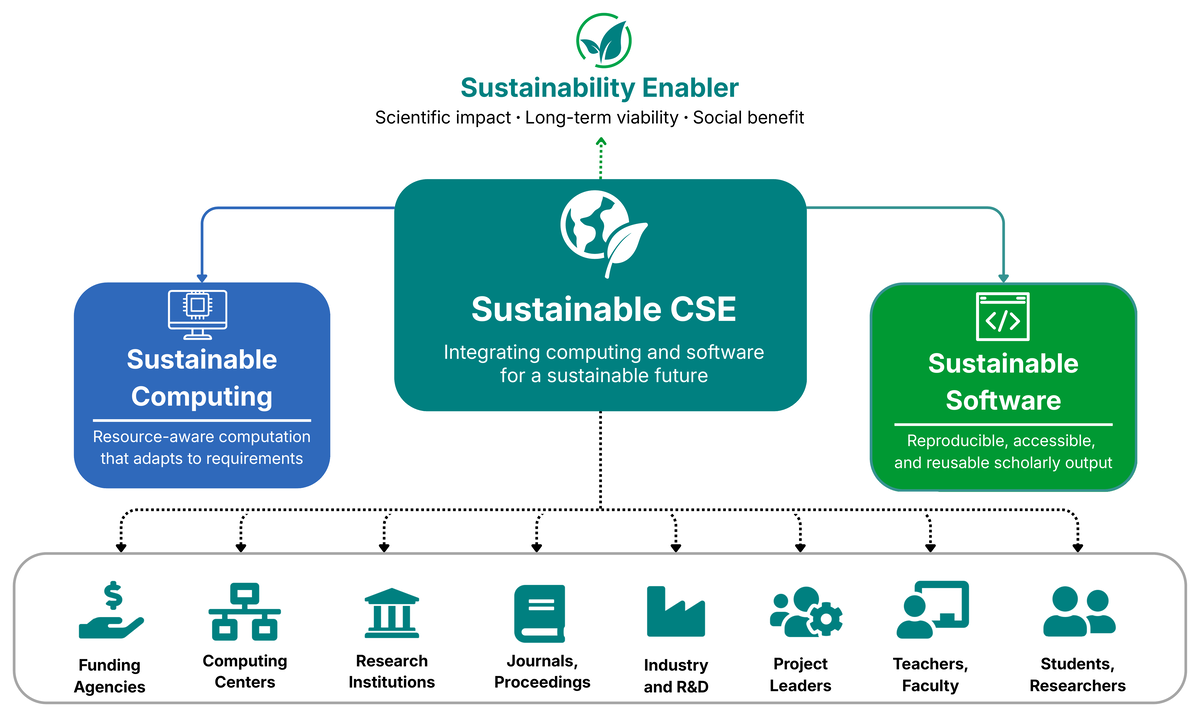
Abstract. Computational Science and Engineering (CSE) combines expertise at the intersection of engineering, applied mathematics, and computer science to form powerful methods for model-based design and model-based decision support across disciplines. Today, CSE methods and tools have an impact as an enabling technology in the development of increasingly sustainable products, processes, and operations. However, sustainability is rarely considered holistically in the context of CSE itself. This paper develops a perspective on sustainability in CSE by distinguishing CSE as an enabler of sustainability in application domains from sustainability within CSE itself, which rests on two complementary pillars: sustainable computing and sustainable software. We present illustrative examples for these pillars and derive recommendations and best practices for CSE stakeholders. Developing an understanding of how sustainability can create added value in CSE is an important future direction for the field. This calls for a concerted effort within the CSE community to define measurable outcomes and best practices that embed sustainability as a core design principle rather than an afterthought.